Popular Courses for Students in Canada in 2024: Trends and Statistics
- June 07, 2024
- 5 min


In 2024, Canada will remain one of the most sought-after destinations for international students seeking higher education. Known for its high-quality education system, cultural diversity, and inclusive environment, Canada attracts students from all over the world. This article explores the popular courses for students in Canada in 2024, supported by genuine statistics and trends that highlight the growing fields of study.
1.Business Administration and Management
Statistics:
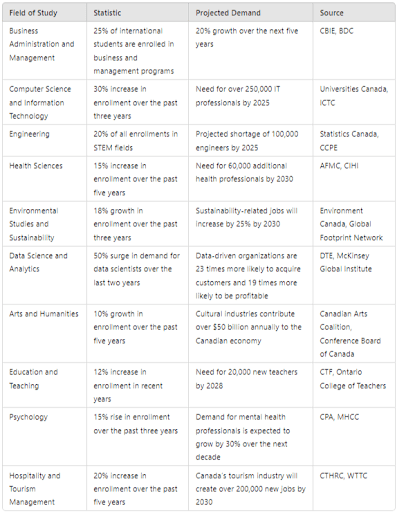
- According to the Canadian Bureau for International Education (CBIE), approximately 25% of international students in Canada are enrolled in business and management programs.
- The Business Development Bank of Canada (BDC) reported that the demand for business graduates is expected to grow by 20% over the next five years.
Business Administration and Management remain at the forefront of popular courses among students. This field offers versatile career opportunities in various sectors, including finance, marketing, human resources, and entrepreneurship. The emphasis on developing managerial skills and business acumen makes these programs highly attractive.
2.Computer Science and Information Technology
Statistics:
- Data from Universities Canada indicates that computer science and IT programs have seen a 30% increase in enrollment over the past three years.
- The Information and Communications Technology Council (ICTC) projects that by 2025, there will be a need for over 250,000 IT professionals in Canada.
With the rapid advancement of technology, the demand for skilled professionals in computer science and IT continues to soar. Courses in this field cover areas such as software development, cybersecurity, artificial intelligence, and data analytics. The tech industry’s robust growth ensures ample job opportunities for graduates.
3.Engineering
Statistics:
- Engineering programs account for about 20% of all enrollments in STEM fields, as per Statistics Canada.
- The Canadian Council of Professional Engineers (CCPE) reports a projected shortage of 100,000 engineers by 2025.
Engineering disciplines, including civil, mechanical, electrical, and chemical engineering, are highly favored by students due to their practical applications and potential for innovation. Canada’s emphasis on infrastructure development and technological advancements further drives the demand for engineers.
4.Health Sciences
Statistics:
- According to the Association of Faculties of Medicine of Canada (AFMC), enrollment in health sciences programs has increased by 15% over the past five years.
- The Canadian Institute for Health Information (CIHI) highlights that there will be a need for 60,000 additional health professionals by 2030.
Health sciences encompass a wide range of programs such as medicine, nursing, pharmacy, and public health. The COVID-19 pandemic has underscored the importance of healthcare professionals, leading to a surge in interest in health-related courses. These programs are crucial for addressing the growing healthcare needs of the population.
5.Environmental Studies and Sustainability
Statistics:
- Enrollment in environmental studies programs has grown by 18% in the past three years, according to data from Environment Canada.
- The Global Footprint Network estimates that sustainability-related jobs will increase by 25% by 2030.
Environmental studies and sustainability programs are gaining traction as awareness about climate change and environmental conservation grows. These courses prepare students to tackle global environmental challenges through sustainable practices, policy-making, and innovative solutions.
6.Data Science and Analytics
Statistics:
- The demand for data scientists in Canada has surged by 50% over the last two years, as reported by the Digital Talent Ecosystem (DTE).
- A study by the McKinsey Global Institute indicates that data-driven organizations are 23 times more likely to acquire customers and 19 times more likely to be profitable.
Data science and analytics are among the fastest-growing fields in higher education. These programs equip students with skills in statistical analysis, machine learning, and data visualization, enabling them to extract meaningful insights from large datasets. The data revolution across industries has made this a highly lucrative career path.
7.Arts and Humanities
Statistics:
- The Canadian Arts Coalition reports a steady increase in enrollment in arts and humanities programs, with a 10% growth over the past five years.
- The Conference Board of Canada highlights that cultural industries contribute over $50 billion annually to the Canadian economy.
While STEM fields often dominate discussions about education trends, arts and humanities remain essential for a well-rounded education. These programs foster critical thinking, creativity, and cultural awareness, preparing students for diverse careers in media, education, public relations, and more.
8.Education and Teaching
Statistics:
- Enrollment in education and teaching programs has seen a 12% increase in recent years, according to the Canadian Teachers' Federation (CTF).
- The Ontario College of Teachers projects a need for 20,000 new teachers by 2028 to address teacher shortages.
Education and teaching programs are vital for developing the next generation of educators. With an aging workforce and increasing student populations, there is a growing need for qualified teachers at all levels of education.
9.Psychology
Statistics:
- Psychology programs have witnessed a 15% rise in enrollment over the past three years, as per data from the Canadian Psychological Association (CPA).
- The demand for mental health professionals is expected to grow by 30% over the next decade, according to the Mental Health Commission of Canada (MHCC).
Psychology remains a popular field of study due to its relevance in understanding human behavior and mental health. Courses in psychology provide students with insights into cognitive processes, emotional well-being, and therapeutic techniques, leading to careers in counseling, clinical psychology, and research.
10.Hospitality and Tourism Management
Statistics:
- The Canadian Tourism Human Resource Council (CTHRC) reports a 20% increase in enrollment in hospitality and tourism programs over the past five years.
- The World Travel & Tourism Council (WTTC) projects that Canada’s tourism industry will create over 200,000 new jobs by 2030.
Hospitality and tourism management programs prepare students for dynamic careers in the travel, leisure, and hospitality sectors. With Canada being a popular tourist destination, there is a consistent demand for professionals who can deliver exceptional service and manage tourism operations effectively.
Conclusion
The landscape of higher education in Canada in 2024 reflects the evolving needs of the global economy and societal priorities. Courses in business administration, computer science, engineering, health sciences, environmental studies, data science, arts and humanities, education, psychology, and hospitality management are among the most popular choices for students. These programs not only offer promising career prospects but also contribute to addressing critical challenges and driving innovation across various sectors.
As Canada continues to attract a diverse student population, its educational institutions are adapting to provide cutting-edge programs that equip students with the skills and knowledge required to excel in their chosen fields. The statistics and trends highlighted in this article underscore the dynamic nature of education in Canada and its role in shaping the future workforce.
Here are the references for the statistics mentioned in the article:
1.Business Administration and Management
- Canadian Bureau for International Education (CBIE) - CBIE International Students in Canada Report
- Business Development Bank of Canada (BDC) - BDC 2024 Business Outlook
2.Computer Science and Information Technology
- Universities Canada - Universities Canada Enrollment Data
- Information and Communications Technology Council (ICTC) - ICTC Labour Market Outlook
3.Engineering
- Statistics Canada - Statistics Canada Education Enrollment Data
- Canadian Council of Professional Engineers (CCPE) - CCPE Engineering Labour Market Report
4.Health Sciences
- Association of Faculties of Medicine of Canada (AFMC) - AFMC Enrollment Statistics
- Canadian Institute for Health Information (CIHI) - CIHI Health Workforce Report
5.Environmental Studies and Sustainability
- Environment Canada - Environment Canada Education Statistics
- Global Footprint Network - Global Footprint Network Sustainability Jobs Report
6.Data Science and Analytics
- Digital Talent Ecosystem (DTE) - DTE Data Science Demand Report
- McKinsey Global Institute - McKinsey Data-Driven Organizations Report
7.Arts and Humanities
- Canadian Arts Coalition - Canadian Arts Coalition Enrollment Data
- Conference Board of Canada - Conference Board of Canada Cultural Industries Report
8.Education and Teaching
- Canadian Teachers' Federation (CTF) - CTF Teaching Enrollment Statistics
- Ontario College of Teachers - Ontario College of Teachers Teacher Demand Report
9.Psychology
- Canadian Psychological Association (CPA) - CPA Psychology Enrollment Statistics
- Mental Health Commission of Canada (MHCC) - MHCC Mental Health Professionals Demand Report
10.Hospitality and Tourism Management
- Canadian Tourism Human Resource Council (CTHRC) - CTHRC Enrollment Data
- World Travel & Tourism Council (WTTC) - WTTC Canada Tourism Jobs Report